
|
AUFGABEN zu Differential-/Integralrechnung |
| [ I N H A L T ] | [ MATHEMATIK Übersicht ] |
Aufgaben zu
13. Winkelfunktionen
13.1 Bogenmaß
 in Grad in Grad |
10° | 23° | 514° | 1265° | 2° | 218° | |||||
| arc |
1 | 0,1 | 2,56 | 0,724 | 75 |
=
 /180° ·
und
= 180°/
· arc
/180° ·
und
= 180°/
· arc
| a. | P ( 2 ; 90° ) | b. | P ( 3 ; 180° ) | c. | P ( 2,5 ; -90° ) | d. | P ( 1 ; 520° ) | |||
| e. | P ( 4 ; -1000° ) | f. | P ( 3 ; 2 ) |
g. | P ( 3 ;  ) ) |
h. | P ( 2 ; -2 /5 ) |
|
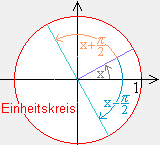 |
| a. | sin x | b. | cos x | c. | tan x | ||
| d. | sin 2 x | e. | sin ½ x | f. | sin ( x + ) |
||
| g. | sin ( 2 x + ) |
h. | sin ( x/3 - 2 ) |
i. | cos ( 3 x + ½ ) |
| a. | y = sin 2 x | b. | y = cos x/2 | c. | y = cos ( - 2 x ) | d. | y = tan x/3 |
| a. | y = - 2 sin x | b. | y = 3 cos x | c. | y = 2 cos ( x - /6 ) |
||
| d. | y = 4 sin ( 3 x + ) |
e. | y = ¼ cos ( x/2 - /2 ) |
||||
| a. | y = sin x + cos x | b. | y = sin x + 2 sin 2 x | |
| c. | y = x + sin x | d. | y = x² + sin x | |
| e. | y = 2 sin x + 3 cos x | f. | y = cos x/2 + sin 2 x |
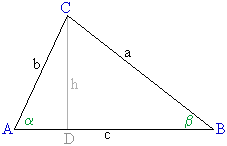
,
 und a gegeben.
Berechne b und beweise so den Sinussatz.
und a gegeben.
Berechne b und beweise so den Sinussatz.
| sin |
= | a | |
 |
|
||
| sin |
b |
bekannt.
Bestimme a und beweise so den Cosinussatz.
| a² = b² + c² - 2 b c ·
cos |
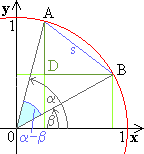
| a. | Nach dem Cosinussatz aus  0AB 0AB |
 |
|
| b. | Nach dem Satz des Pythagoras aus ADB. |
||
| Zeige: | | B D | = cos
- cos |
||
| | A D | = sin
- sin |
|||
| c. | Durch Gleichsetzung der beiden Werte für s² erhält man das Additionstheorem. | ||
| ( A ) | cos (
- ) =
cos
· cos
+ sin
· sin |
||
durch ( - ) , erhält man aus ( A ) in Aufgabe 10.:
| cos (
+ ) =
cos
· cos
- sin
· sin |
| sin (
+ )
= sin
· cos +
cos
· sin |
und | |
| sin (
- )
= sin
· cos
- cos
· sin |
her. |
( 90° - ) und danach
( - ) für
.
| a. | sin 2 = 2 cos
sin |
b. | cos 2 =
cos² -
sin² |
|||
| c. | tan ( ±
) |
d. | tan 2 = |
2 tan |
||
|
||||||
| 1 - tan² |
||||||
| e. | sin² =
½ ( 1 - cos 2 ) |
f. | cos =
2 cos² /2 - 1 |
|||
| sin x + sin y = 2 · sin | x + y | · cos | x - y | |
|
|
|||
| 2 | 2 | |||
| sin x - sin y = 2 · sin | x - y | · cos | x + y | |
|
|
|||
| 2 | 2 |
+
und
y = -
und wende geeignete Additionstheoreme an.)
weitere Aufgaben zu
13.7 Lineare Approximation der sin-Funktion

 zurück zu MATHEMATIK Übersicht